What does JPK CIT reporting involve?
JPK CIT is a new standard for digital reporting of financial and tax data that significantly changes how accounting books are maintained and how CIT settlements are prepared. Companies are required not only to keep their records in electronic form but also to submit them annually to the tax administration as structured XML files. In practice, this means the need to integrate accounting data with tax information and to adjust financial systems and the chart of accounts.
-
Who is required to file the JPK CIT report?
In three consecutive phases, the reporting obligation applies successively to: CIT taxpayers and partnerships whose revenue in the previous tax year exceeded 50 million euros, and Tax Capital Groups (PGK). Next: CIT taxpayers and partnerships, as well as PIT taxpayers who maintain accounting records. In the third stage: the remaining CIT taxpayers and partnerships, as well as the remaining PIT taxpayers who maintain accounting records.
-
What are the benefits of reporting your JPK CIT with Grant Thornton?
Grant Thornton’s expert support around JPK CIT ensures security, regulatory compliance, and peace of mind, allowing you to focus on growing your business without worrying about regulatory changes or the technical aspects of reporting. Furthermore, it helps mitigate the risks associated with new obligations and prepares your organization for continued digitization of tax and accounting processes.


JPK CIT reporting includes two main structures:
1. JPK_KR_PD – accounting books with, among others, following data:
- contractors’ tax identification numbers (NIP)
- numbers of invoices from National e-Invoicing System (KSeF)
- account tags mapping ledger accounts to the balance sheet and profit and loss statemen
- differences between financial result and tax base
JPK_ST_KR – data from fixed assets and intangible assets registers.
Is your company already subject to JPK_CIT reporting?
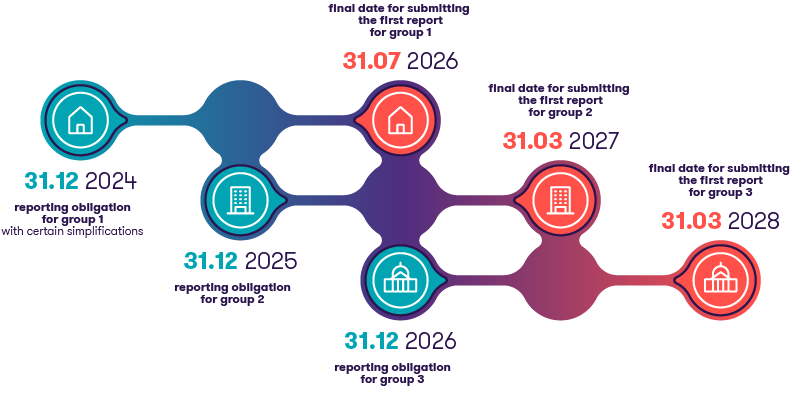
Group 1: Tax Capital Groups and the largest CIT taxpayers (revenues above EUR 50 million) prepare and submit the JPK_KR_PD structure for the first time for the 2025 tax year
Group2: CIT taxpayers submitting monthly VAT returns file JPK CIT (both structures) for the first time for the 2026 tax year
Group3: All remaining CIT taxpayers will be required to report for the 2027 tax year
For entities with a non-calendar tax year, the deadlines are shifted accordingly:
- by the end of the seventh month after the end of the tax year – in the first implementation stage,
- by the end of the third month after the end of the tax year – insubsequentyears.
Scope of JPK CIT support:
-
Adjustment of the chart of accounts to JPK_KR_PD requirements
-
Assignment of tags, account mapping and tax linkages
-
Verification of data completeness and consistency for reporting purposes
-
Technical preparation of JPK CIT files
-
Support in adapting accounting systems and financial processes
JPK CIT reporting process with Grant Thornton
-
Client needs analysis
We begin with a review of the financial and accounting environment and identify areas requiring adjustment. We analyse the chart of accounts structure, data recording practices, and system readiness for JPK CIT reporting.
-
Reporting preparation
Based on the assessment, we implement the necessary changes: tagging accounts and transactions, organising data and supporting accounting system adjustments. Where required, we also assist in preparing files based on data from systems that have not yet been fully adapted to the new requirements.
-
Ongoing reporting
After implementation, we either take over the process or support the Client in the regular preparation, verification and submission of JPK CIT files. We monitor regulatory changes, ensure data accuracy, and maintain continuity and security of reporting.
We begin with a review of the financial and accounting environment and identify areas requiring adjustment. We analyse the chart of accounts structure, data recording practices, and system readiness for JPK CIT reporting.
Award-winning outsourcing
Our expertise and experience make us a reliable partner in the secure growth of companies of all sizes, across virtually every sector and location.
For over 30 years, our team has guaranteed service continuity, unlocking our clients’ potential to achieve steady and expected growth, while also giving them peace of mind by reducing the risks associated with tax compliance. Our professionalism and expertise have been recognized numerous times with industry awards, including “Reliable Outsourcer” and “Outsourcing Star.” We offer innovative tools, such as the GT e-Financial Statements application. Thanks to the support of the global Grant Thornton network, comprising over 40,000 employees from 140 countries, we offer comprehensive, world-class services. We look forward to working with you!
-
30+
years of operation in Poland
-
1200+
employees across 7 offices
-
2500+
satisfied clients