Industries such as technology, healthcare, renewable energy, and logistics are consistently attracting investors’ attention. However, while the opportunity is significant, executing an acquisition in Poland requires careful navigation of legal, regulatory, and transactional risks. This article outlines a practical legal roadmap for foreign investors interested in acquiring a business in Poland.
Global Standards vs. Local Market Realities
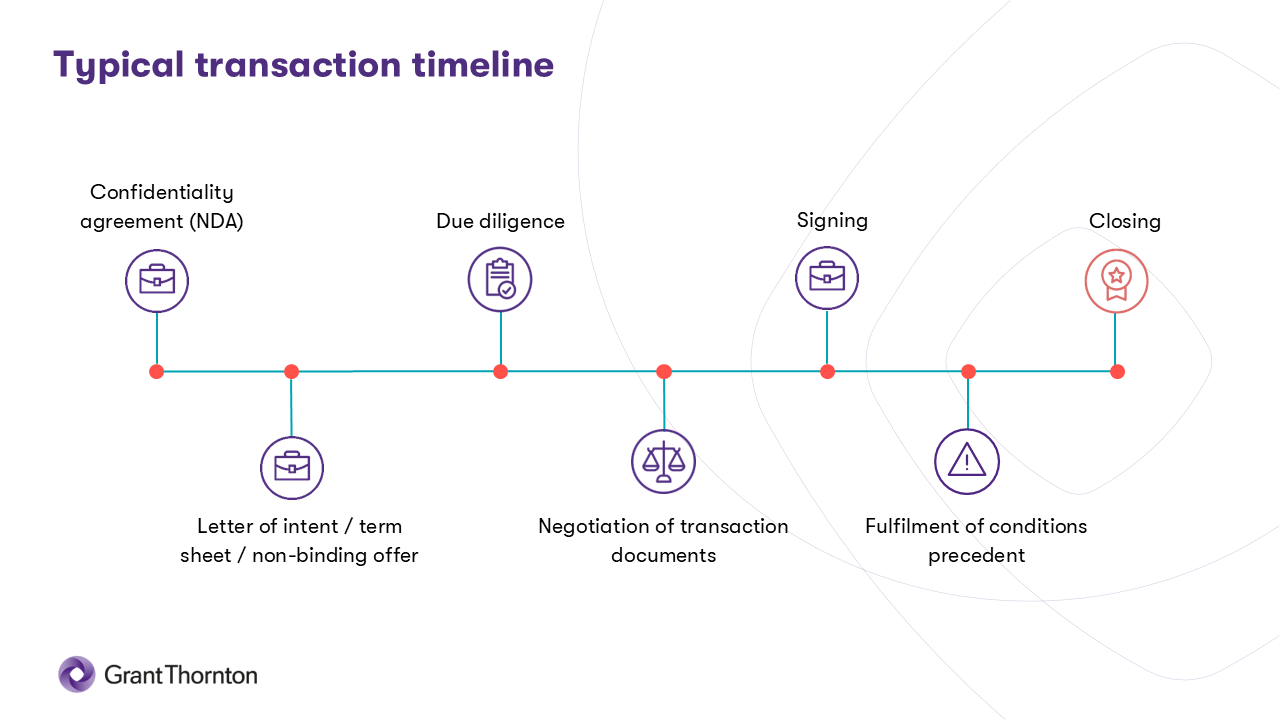
From a structural perspective, M&A transactions in Poland follow globally recognized standards. The typical transaction process includes: the signing of a non-disclosure agreement (NDA), agreeing on key business terms in a term sheet or letter of intent, due diligence examination of the target, negotiation and signing of the legal documentation (including the investment agreement), fulfillment of the conditions precedent and closing.
However, what differentiates Poland is not the structure of the process itself, but how transactions are executed in practice. The Polish M&A market is highly competitive therefore acquisition processes are frequently run as competitive auctions, with multiple potential buyers competing for the same target. Moreover, transactions are characterized by a relatively lower level of trust and a higher level of formalism, which translates into more detailed transactional documentation, stronger reliance on written representations, disclosure mechanisms and collateral.
In practice, this means that while foreign investors will recognize the overall framework, they should be prepared for more intensive documentation and negotiation processes than in some Western European markets.
Regulatory Landscape
In Poland – as in any other jurisdiction – regulatory and third-party consents play a key role at the pre-closing stage of a transaction. From a practical perspective, early identification of required consents is critical. Failure to properly identify and address this issue may delay or even prevent closing. It should also be pointed out that finalizing the transaction without required consent may render the whole process null and void.
In M&A transactions, the most common regulatory approval is connected to merger control. In Poland, the competent authority in this field is the President of the Office of Competition and Consumer Protection. A merger is subject to control if certain turnover thresholds are exceeded, in particular where the aggregate worldwide turnover of the entities participating in the merger exceeds EUR 1,000,000,000 in the financial year preceding the notification, or where their aggregate turnover generated in Poland exceeds EUR 50,000,000. It is worth noting that the obligation to obtain antimonopoly clearance does not apply, if the turnover generated in Poland by the entity over which control is to be acquired did not exceed EUR 10,000,000 in either of the two financial years preceding the notification. This exemption is particularly relevant in transactions involving relatively small targets, even where the acquiring party operates on a significantly larger scale.
A critical element of transaction structuring, in particular in case of deals involving real estates or companies owning real estates, is connected with the agricultural land. The National Support Centre for Agriculture (pol. Krajowy Ośrodek Wsparcia Rolnictwa or KOWR) has a statutory right of first refusal with respect to shares in companies owning agricultural land with an area of at least 5 hectares. Moreover – in the case of asset deals – the acquisition of agricultural real estate of at least 1 hectare requires obtaining prior consent of KOWR. It may pose a significant practical obstacle, as the granting of such consent is conditional, inter alia, upon the purchaser’s undertaking to conduct agricultural activity on the acquired property for a period of at least five years following the completion of the transaction. The above-mentioned issue is even more significant, taking into account that under Polish law the term “agricultural land” is interpreted broadly and encompasses not only property currently used for agricultural purposes, but also land that is merely capable of being used for such purposes, even if it is not so utilized at a given time and even if the company itself does not conduct agricultural activity.
An additional regulatory layer concerns foreign direct investment (FDI) regulations aimed at safeguarding public order and national security by subjecting selected transactions – involving foreign investors – to prior approval by the relevant ministry. These regulatory approvals concern entities operating in sectors of strategic importance to the state, such as energy, fuel, telecommunications, or chemical industries.
If the seller is a natural person who is married and has joint marital property, it is worth obtaining the consent of the spouse to the transaction. In such case, the investor will be entitled to seek compensation for any claims he may have against the seller not only from the private assets of the seller, but also from the assets constituting part of his joint marital property.
Moreover, transactions may also require approvals from – among others – contractual counterparties or corporate bodies of the relevant entity. The required consents should be identified early in the due diligence of the target to allow for proper transaction structuring and development of a realistic schedule for the transaction.
What Typically Surprises Foreign Buyers in Poland
While due diligence is a standard element of any M&A process, certain findings recur in Poland and may come as a surprise to foreign investors. The most common risk areas include:
- employment issues, in particular the use of B2B contracts instead of employment agreements and irregular bonus schemes or remuneration practices,
- incomplete or improperly implemented compliance procedures, in particular in the field of data protection or anti-corruption,
- issues relating to real estate, in particular defects in legal title, as well as irregularities in construction processes, statutory pre-emption rights, or various environmental risks including contamination,
- disputes and hidden liabilities, in particular off-balance sheet liabilities or contingent risks.
Identified risks are typically addressed through specific indemnities and tailored warranties, price retention mechanisms, escrow arrangements, or price adjustments.
Poland offers compelling M&A opportunities, but success depends on a well-managed transaction process, including adequate transaction structuring, proper identification of potential risks, and addressing them in the transaction documentation. With the right support, investors can navigate complexities, protect value, and unlock long-term growth potential.
