This ecosystem streamlines document workflows and reduces administrative burdens while simultaneously expanding the scope of data available to public authorities. For businesses, this creates both new opportunities and new questions regarding compliance obligations, information flows, and the growing transparency of business processes.
spis treści
- HR process digitalization - new opportunities
- What opportunities does the government’s e-Contracts System offer?
- Greater accessibility of electronic signatures through the mObywatel app
- Digital Ecosystem: e-Contracts + qualified electronic signature + KSeF
- What benefits does increasing digitalization bring to businesses?
- What challenges do businesses face as digitalization accelerates in Poland?
HR process digitalization – new opportunities
Just a few years ago, the digitalization of HR functions was primarily associated with the introduction of electronic employee records. The possibility of maintaining employee documentation in electronic form was introduced into the Polish legal system under the Regulation of the Minister of Family, Labour and Social Policy on employee documentation of 10 December 2018 and marked one of the most significant steps towards modernizing HR processes.
Electronic employee files have not only reduced the reliance on paper-based document workflows but have also improved access to employee data and enhanced information security.
However, practice shows that the pace of change is slower than one might expect. According to Grant Thornton’s recurring report, “Digitalization of Employee Documentation: Employers’ Views on the Implementation of Electronic Employee Files,” only 10.5% of businesses maintain personnel records in electronic form, while just 27.6% plan to implement electronic employee files within the next 12 months. This represents a decline of nearly 10 percentage points compared to the previous year. The findings point to growing caution among employers, whose main challenges continue to include adapting internal processes, ensuring regulatory compliance, and managing other ongoing regulatory and technological projects.
It is also important to remember that implementing electronic employee files involves much more than simply replacing paper documents with digital versions. It is a complex process that requires proper organizational preparation, robust data security measures, and integration with existing HR and payroll systems.
Important
Importantly, companies do not need to begin their transformation journey with the most complex projects. The first step may involve the digitalization of simpler areas, such as: electronic leave request workflows, online access to payslips, digital management of business travel documentation.
Publicly provided digital solutions are also playing an increasingly important role, helping businesses gradually build a digital work environment while reducing barriers to adoption. In 2026, several new solutions were introduced, including the e-Contracts System and electronic signature services available through the mObywatel app.
It is worth noting that the digitalization of interactions between businesses and public administration has been progressing for several years. Today, PIT-11 information returns and PIT-4R declarations are submitted to the authorities exclusively in electronic form. Businesses can also make use of the e-Tax Office, which enables many tax-related matters to be handled online without the need to visit a tax office in person. These developments demonstrate that digital document workflows are becoming the norm not only in HR operations but also in interactions with the tax administration.
What opportunities does the government’s e-Contracts System offer?
At the beginning of 2026, the Polish government launched the e-Contracts System, a platform that enables the conclusion, amendment, and termination of contracts in electronic form. The tool supports various types of agreements, including employment contracts, mandate contracts, and service agreements. In addition, users have access to ready-made document templates and related documents, such as contract amendments and employment certificates. Documents created within the system can be signed using a qualified electronic signature, a trusted profile signature, or a personal signature.
Moreover, the government solution offers far more functionality than contract management alone. It enables, among other things:
- the maintenance of electronic employee records, primarily for newly hired employees. By choosing to conclude an employment contract through the e-Contracts System, employers can simultaneously manage employee documentation within the same digital environment, ensuring continuity throughout the entire employment lifecycle, from onboarding to termination;
- integration with reporting and registration processes involving the Social Insurance Institution (ZUS) and the National Revenue Administration (KAS);
- management of the full document lifecycle, from its creation to the end of the legal relationship.
It is worth emphasizing that this solution may be particularly beneficial for microenterprises and small businesses, which often lack extensive HR resources or dedicated HR systems. In practice, the e-Contracts System can serve as a free tool supporting basic HR processes. For smaller organizations, this creates an opportunity to standardize and centralize employment-related documentation while reducing the need to use multiple separate tools. As a result, administrative processes may become simpler, more organized, and less time-consuming, allowing business owners to focus more on their core operations. It should be noted, however, that access to the e-Contracts System is currently not available to all businesses. The solution was designed primarily for microenterprises, entities employing up to nine employees, farmers, and individuals employing childcare providers. As a result, its application within larger organizations remains limited, and such companies will continue to rely mainly on their own HR systems and document management workflows.
Greater accessibility of electronic signatures through the mObywatel app
A key element of an effective digital document workflow is the electronic signature. Until now, access to such a solution has been one of the main barriers to the wider adoption of digitalization. Commercial electronic signature solutions involved additional costs, often ranging from several hundred to several thousand PLN, which significantly limited their widespread use.
A breakthrough in this area may come with the introduction of a free qualified electronic signature within the mObywatel app. Like its commercial counterparts, it has the same legal validity as a handwritten signature and is recognized throughout the European Union. As a result, documents can be signed entirely remotely, reducing the time needed to complete formalities and removing some of the barriers associated with document workflows.
However, it is important to be aware of the limitations of this solution. The free qualified electronic signature available through the mObywatel app was designed primarily for private use. It cannot be used by employers to perform HR-related activities on behalf of an organization. In practice, this means that businesses will still require appropriate solutions enabling documents to be signed as part of their commercial activities and HR processes.
Digital Ecosystem: e-Contracts + qualified electronic signature + KSeF
The launch of the e-Contracts System and the introduction of qualified electronic signatures through the mObywatel app form part of a broader strategy aimed at the digitalization of public administration and business transactions. Another key element of this strategy is the National e-Invoicing System (KSeF), which centralizes the issuance and circulation of invoices.
As a result, a coherent model is emerging in which contract execution (e-Contracts), contract authorization (qualified electronic signature), and settlement processes (KSeF) can all be carried out within a single, integrated digital environment. This represents a significant qualitative shift. The lifecycle of a business relationship is no longer fragmented across multiple tools and processes. Instead, it increasingly operates within a structured and interconnected data ecosystem
What benefits does increasing digitalization bring to businesses?
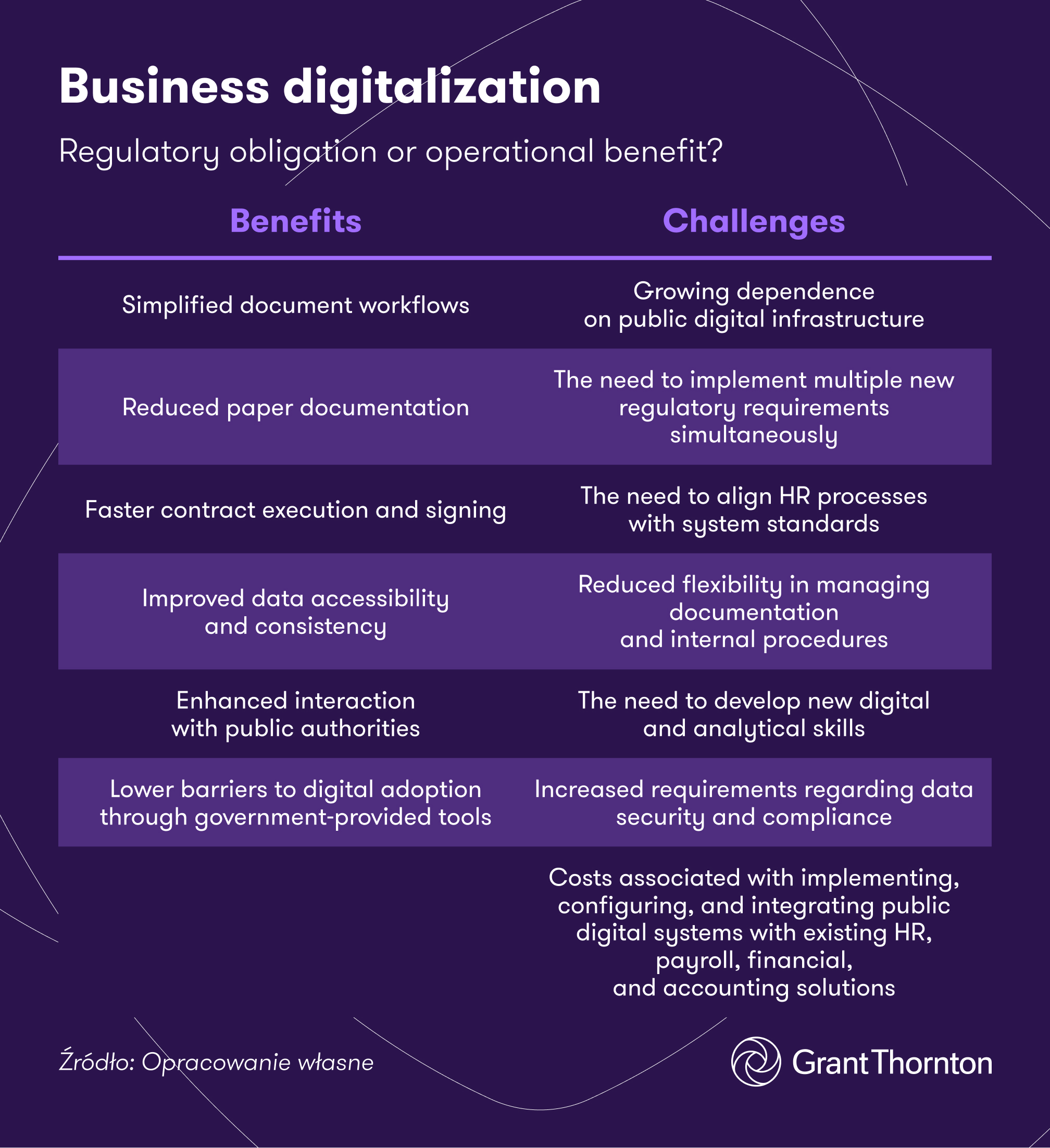
Digitalization should be viewed from a broader perspective than simply the intensive period of preparation and implementation. In the long term, it delivers tangible benefits to businesses. First and foremost, it streamlines processes by reducing the need to print documents and manage their physical circulation. Another important advantage is the growing availability of digital tools supported by public administration. Although many of these solutions are provided free of charge, businesses must still take into account the costs associated with implementation and integration with their existing business systems. Nevertheless, such solutions can facilitate digital document workflows and lower barriers to adoption, particularly for smaller organizations.
Digitalization also contributes to greater operational efficiency. Today, contracts can be concluded and signed within minutes, regardless of where the parties are located. An additional benefit is improved data consistency and accessibility, made possible through document standardization and the integration of systems used by both public authorities and businesses
What challenges do businesses face as digitalization accelerates in Poland?
The ongoing wave of digitalization brings with it a number of new obligations that companies must implement simultaneously, often within a very short timeframe. For many organizations, this means adapting not only their processes and systems, but also the way they manage documentation and data.
important
The most significant challenges today include: growing reliance on public digital infrastructure, the need to align HR processes with standardized system requirements, reduced flexibility in managing documents and internal procedures.
It is also important to emphasize that digitalization is significantly reshaping organizational roles. Departments responsible for HR and administrative functions are increasingly moving beyond traditional document management responsibilities and becoming responsible for data governance, access management, and ensuring the proper flow of information within digital systems. This shift requires the development of new competencies, not only in technology, but also in data security, regulatory compliance, and risk management.
Conslusion
Poland is consistently building a digital state model in which key document-related processes are gradually being transferred to public systems. In 2026, particular importance is attached to new solutions such as the e-Contracts System, the qualified electronic signature available through the mObywatel app, and the National e-Invoicing System (KSeF). At the same time, the regulatory environment continues to evolve. For example, amendments to the legislation governing the National Labour Inspectorate (PIP) expand the possibilities for data exchange between public institutions, strengthening the integration of the labour market supervision framework.
All of these developments contribute to the creation of an increasingly integrated data ecosystem covering both employment and business relationships. On the one hand, this enhances transparency, system consistency, and reduces the risk of irregularities, including activity within the so-called shadow economy. On the other hand, it leads to increased oversight of the labour market and greater visibility of business processes within public administration systems.
This raises an important question: to what extent does this direction genuinely simplify and streamline business operations, and to what extent does it increase the monitoring and scrutiny of entrepreneurial activity? A reliable assessment of this balance will only be possible after several years of operation, when the full impact of these new systems on the day-to-day functioning of businesses becomes evident.
